
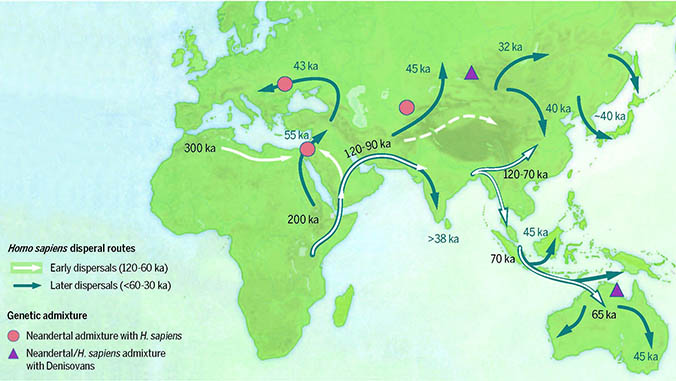
Sapiens from a single source population in Africa which expanded and led to the extinction of all other human varieties while the multiregional evolution. Sapiens migrated to southern China between 120 kya and 80 kya and Europe about 4543 kya.
 On The Origin Of Modern Humans Asian Perspectives Science
Most notable is the Southern Dispersal of H.

Emergence and dispersal of modern homo sapiens. Gene flow between populations at the edges of larger regions prevented divergence into more then one species. The derivation of a comparatively homogeneous single species of H. CAJ 11 516.
However the central question of why it took these populations 100000 years to disperse from Africa to other regions of the world has never been clearly resolved. Scientific study of human evolution is mostly concerned with the development of the genus Homo but usually involves studying other hominids and hominines as well such as Australopithecus. Recent African origin postulated the emergence of H.
The time frame for the evolution of the genus Homo out of the last common ancestor is roughly 10 to 2 million years ago that of H. Within 150000 years or so their descendants had spread across most of the Old World even expanding as far as Australia and somewhat later to the Americas. Sometime probably close to 200000 ya the first modern Homo sapiensevolved in Africa.
Among extant populations of Homo sapiens the deepest temporal division is found in the San people of Southern Africa estimated at close to 130000 years or possibly more than 300000 years ago. Some of them migrated into North America via the Bering Plain or Beringia by 20000-15000 years ago. Sapiens from more diverse varieties of archaic humans all of which were descended from the early dispersal of H.
A study has concluded that the earliest ancestors of anatomically modern humans Homo sapiens sapiens emerged in a southern African homeland and thrived there for 70 thousand years. Modern humans reached the Japanese Islands by 30000 years ago or somewhat earlier. First modern Homo sapiens appeared in Africa 200000 yBP.
Arising from a 2011 symposium sponsored by the National Museum of Nature and Science in Tokyo this book gathers the work of archaeologists from the Pacific Rim of Asia Australia and North America to address the relative lack of attention given to the emergence of modern human behavior as manifested in Asia during the worldwide dispersal. Homo sapiens arose from Homo ergaster populations in different areas after they moved outside of Africa. 300000 to 200000 years ago in contrast to Out of Africa I which refers to the migration of archaic humans from Africa to Eurasia roughly 18 to 05 million years ago.
The earliest traces of Homo erectus have been uncovered in eastern Africa where fossils from the Turkana basin are 17 to 18 million years in age. Sapiens around 60 kya which led to the lasting peopling of Oceania and Eurasia by anatomically modern humans. Who were they and why were these early modern people so successful.
Sapiens interbred with archaic humans both in Africa and in Eurasia in Eurasia notably with Neanderthals and Denisovans. Molecular genetic data suggest that early H. Two main hypotheses i.
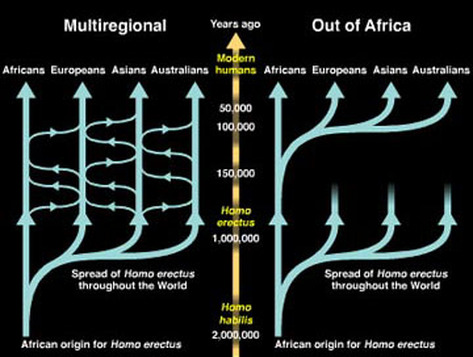
Recent African origin or Out of Africa II refers to the migration of anatomically modern humans Homo sapiens out of Africa after their emergence at c. This process involved the gradual development of traits such as human bipedalism and language. Erectus some 18 million years ago was debated in terms of two competing models during the 1980s.
A model and its implications for the emergence of modern human culture. Around 35000-30000 years ago Homo sapiens big game hunters moved into Northeastern Siberia. He also draws on information and complexity theory to explain the emergence of Homo sapiens in Africa several hundred thousand years ago and the rapid and unprecedented spread of our species into a variety of environments in Australia and Eurasia including the Arctic and Beringia beginning between 75000 and 60000 years ago.
He also draws on information and complexity theory to explain the emergence of Homo sapiens in Africa several hundred thousand years ago and the rapid and unprecedented spread of our species into a variety of environments in Australia and Eurasia including the Arctic and Beringia beginning between 75000 and 60000 years ago. In the 1940s a multi-regional origin model was first proposed. Sapiens out of Homo erectus roughly 18 to 02 million years ago.
THE DISPERSAL OF HOMO ERECTUS FROM AFRICA AND THE EMERGENCE OF MORE MODERN HUMANS G. A dispersal of Homo sapiens from southern to eastern Africa immediately preceded the out-of-Africa. Out of Africa 1 ModernHomo sapiensevolved in Africa and then spread to Asia and Europe where modern humans replaced the populations there.
Sapiens passed through a population bottleneckthat is a period when they were rare creaturesbefore rapidly spreading throughout the Old World. Recent research has provided increasing support for the origins of anatomically and genetically modern human populations in Africa between 150000 and 200000 years ago followed by a major dispersal of these populations to both Asia and Europe sometime after ca. Omo-Kibish I Omo I from southern Ethiopia is the oldest anatomically modern Homo sapiens skeleton currently known 196 5 ka.
65000 before present BP. In the long run from 60 million years ago to 60000 years ago the global super-cycle moved from Greenhouse to Icehouse from a warm carbon-rich world in which ferns grew and dinosaurs grazed at the earths polar extremes to a cold carbon-depleted world where a new humanity stood on dry equatorial African shores on the edge of a global colonization leading to our very recent past. Emergence and Diversity of Modern Human Behavior in Paleolithic Asia focuses long-overdue scholarly attention on this under-studied area of the world.
Human evolution is the evolutionary process that led to the emergence of anatomically modern humans beginning with the evolutionary history of primatesin particular genus Homoand leading to the emergence of Homo sapiens as a distinct species of the hominid family which includes the great apes. It has been clear for some time that anatomically modern humans appeared in Africa roughly 200000 years ago What has long been debated is the exact location of this emergence and subsequent. Philip Rightmire Department of Anthropology State University of New York Binghamton NY 13902-6000 USA.
 The Similarity In Features Finally Puts To Rest The Long Standing Controversy Over The Origin Of Modern Humans While It Is Kno Human Evolution Hominid Sapiens
 Migration Mystery Who Were The First Americans Human Migration History Geography Migrations
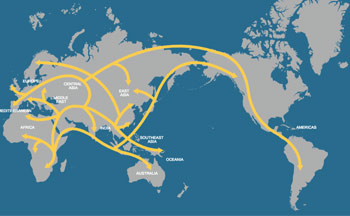 Human Migration Out Of Africa The Human Journey
 Pin On Wiedza
 The Archaeology News Network Out Of Africa Did Humans Migrate Quickly And All At Once Or In Phases Based On Weather Human Migration Out Of Africa History
 Early Human Migrations Wikipedia
 The Archaeology News Network First Australians May Have Arrived In Large Groups Archaeology News Historical Maps Aboriginal Culture
 Genetic Evidence For Early Modern Human Migration Pathways Historical Maps Ancient Humans History Geography
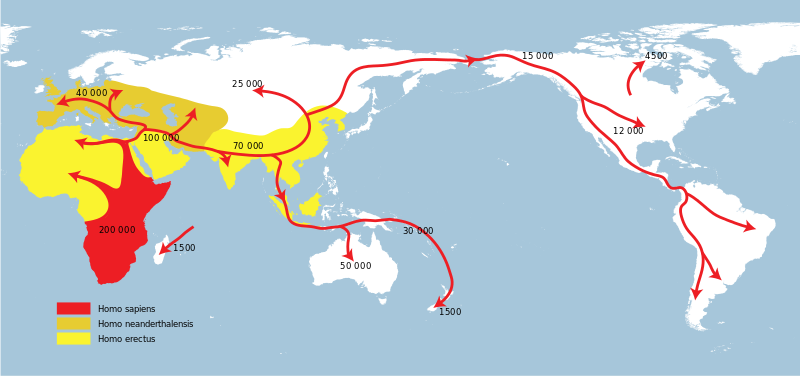
 The Southern Dispersal Route A Possible Pathway Out Of Africa Out Of Africa Africa Route
 Pin On History Two
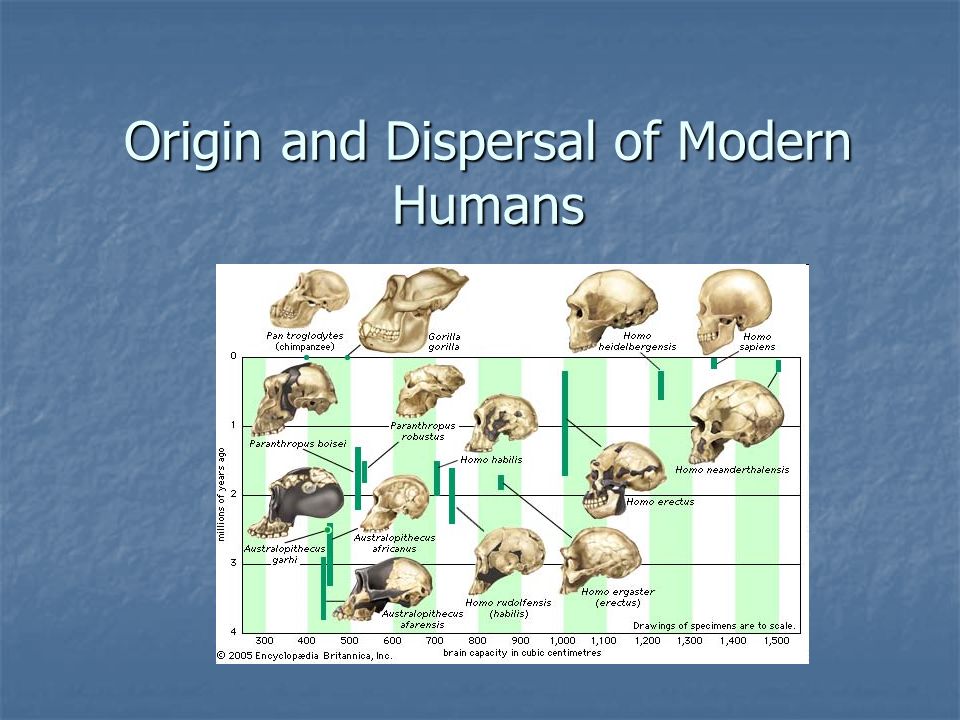 Origin And Dispersal Of Modern Humans Homo Sapiens Approximately 200 Kya The First Homo Sapiens Evolved In Africa Approximately 200 Kya The First Homo Ppt Download
 Early Human Migrations Wikipedia
 Pin On Anthro
 Ancient Dispersal Patterns Of Modern Humans During The Past 100 000 Y Download Scientific Diagram
 Dna Of Early Neanderthal Gives Timeline For New Modern Human Related Dispersal From Africa Neanderthals Received Genetic Contribution From Africa By Hominins T
 E302b World Map Of Y Dna Haplogroups Png 1600 880 Ahnenforschung Genetik Historische Karten